AI-native operations that scale without scaling complexity.
Secular Labs designs and implements autonomous enterprise systems that combine AI agents, deterministic workflows, verification protocols, and human exception handling to automate information-intensive business operations.
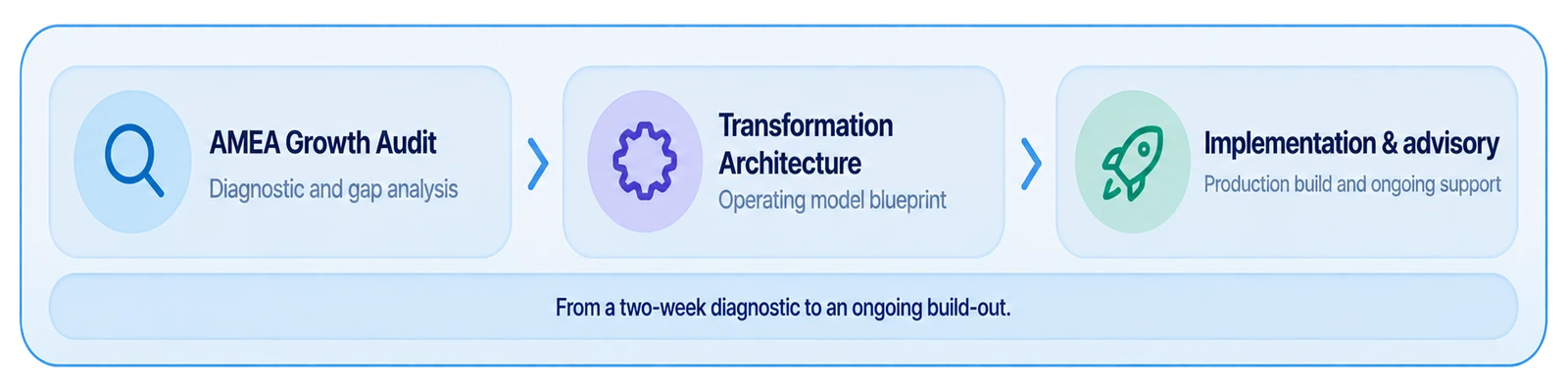
From a two-week diagnostic to an ongoing build-out.
-
01
AMEA Growth Audit
A structured gap-analysis of your current operating model against the AMEI framework's AMEA architecture — where headcount is standing in for orchestration, where verification is missing, and what growth path actually exists. For an established business, that's usually a 3–4x path; for a startup or early-stage company with no legacy process to unwind, it can be considerably higher — 50–100x isn't unusual. The audit is the fastest way to find out which applies to you.
-
02
Transformation Architecture Design
We translate the audit into a practical operating blueprint: which functions move to agent orchestration, what data and retrieval layer they need, and what governance has to sit in front of them before anything goes live.
-
03
Implementation & fractional advisory
Ongoing engagement where we help build out the agreed architecture — using the same open-source, self-hostable stack described in How We Work — and stay on as a fractional advisor as the system, and the organization around it, matures.
Engagement scope and duration are set per client.
Tell us about your business and where you're seeing operational bottlenecks — we'll get back to you to begin the assessment.
Where the coordination tax is being productised
In every operational domain we look at — publisher monetisation, AR collections, logistics claims, underwriting, returns — the same structure shows up: coordination and verification still sit with people. A small number of teams have productised that layer, and now grow capacity without matching headcount.
These are market patterns, not our work. They illustrate the structural move we diagnose.
Aditude — Publisher monetisation
Unified monetisation stack, services → SaaS. Roughly $5M ARR in about 18 months with a founder and three engineers.
What it tells us: the coordination tax in publisher ops can be productised, not staffed.
Paraglide — AR / collections
Agents handling invoice Q&A, collections and escalation across fragmented finance data. Customer-reported ~34% reduction in days-sales-outstanding within weeks.
What it tells us: collections is pure coordination plus exceptions — exactly the shape agents handle well.
Swivel — Sell-side ad ops
Agentic trafficking, yield and floor management. Founded ~2023, ~$5.8M Series A, small team, millions of automated actions.
What it tells us: ops scales; headcount doesn't have to.
Poetic — Insurance underwriting
Agents for underwriting, fraud and compliance in a regulated, verification-heavy environment.
What it tells us: autonomy works when residual risk is bounded — architecture before AI.
Same architecture, different surface. That's what we diagnose.
Examples above are publicly documented market patterns, illustrative only. None of these companies is a client, partner, or endorsement of Secular Labs.
-
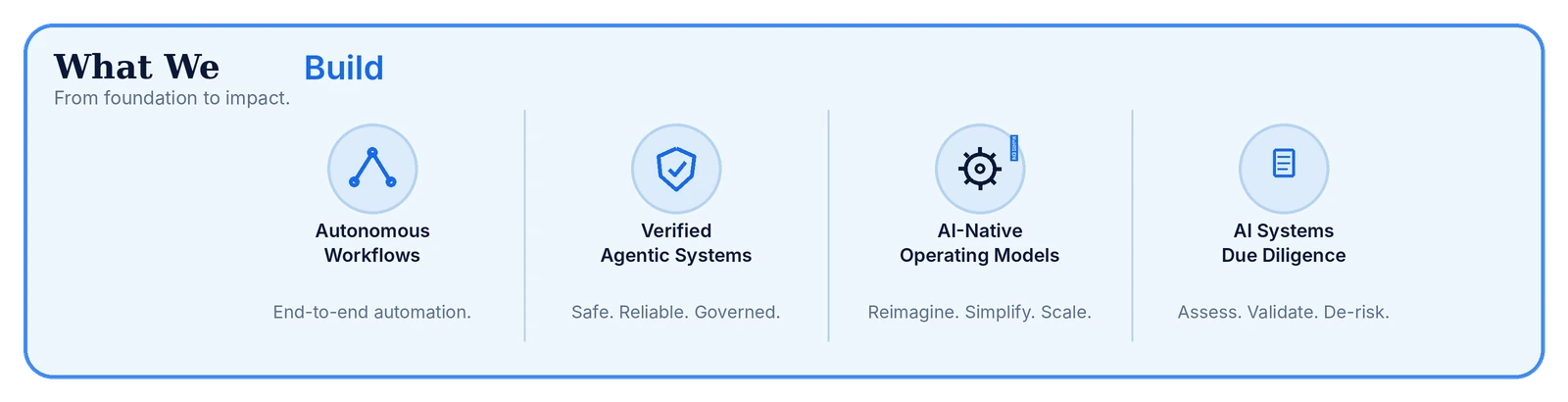
Autonomous Workflows
Transform recurring analytical, operational, and coordination-intensive workflows into AI-native execution systems — the everyday work that currently absorbs headcount without needing human judgment at every step.
-
Verified Agentic Systems
Multi-agent architectures with deterministic validation, state controls, rollback mechanisms, and human escalation — so autonomy doesn't mean giving up control.
-
AI-Native Operating Models
Identify where AI can replace or augment recurring coordination work, and redesign the operating model around the resulting economics — not bolt automation onto an unchanged org chart.
-
AI Systems Due Diligence
Evaluate autonomous systems for verification quality, compute economics, model-provider dependency, governance, and operational resilience — for your own systems, or a company you're considering investing in.
Find where AI can create operational leverage.

-
01
Diagnose
Identify workflows, bottlenecks, and sources of unnecessary operational overhead.
-
02
Redesign
Determine what should be automated, what should remain human, and where verification is required.
-
03
Implement
Deploy production workflows around the highest-value opportunities.