Market patterns
The coordination tax is being productised
Across publisher ad ops, AR collections, logistics claims, underwriting and returns, the same structural pattern is showing up. Small teams are scaling output without matching headcount by rebuilding the coordination layer of the business — not by adding people to it.
The pattern
Every recurring operational workflow has three layers:
-
01
Coordination
Information moves between people and systems. Someone prepares, routes, checks and commits work.
-
02
Decision
A rule or a judgment is applied.
-
03
Verification
The result is confirmed, reconciled, or escalated.
For most businesses, the first and third layers consume the majority of operational headcount — not because the work is complicated, but because coordination is manual and verification is done by people reading outputs. As volume grows, headcount grows proportionally. That's the coordination tax.
A pattern is emerging across industries: teams that productise the coordination and verification layers — with rules, integrations, and narrowly scoped AI — grow capacity without growing headcount the same way. They don't replace their people. They change what their people do.
The examples below are publicly documented market patterns. They are not our clients and we are not endorsing them. They illustrate the same structural move we diagnose.
How to read the framework tags
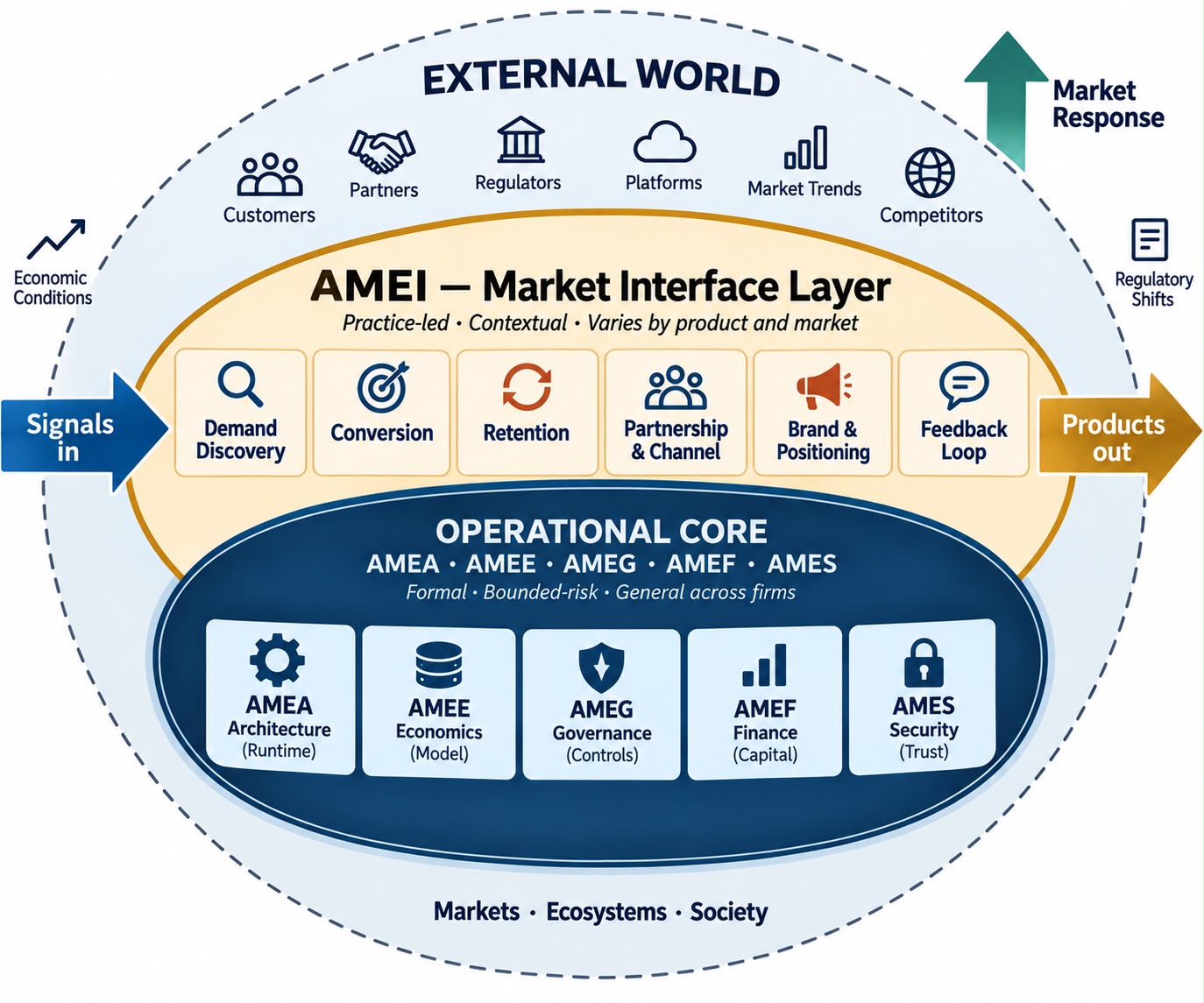
Each pattern below is tagged with the AMEA pillar it exercises most heavily. AMEA is the five-pillar operational core we use to structure operational analysis:
Most real workflows touch all five. The tags indicate where the pattern's leverage is concentrated, not where it stops.
AdTech / publisher ops
Aditude — Publisher monetisation
Tag: AMEA (Architecture / Runtime)
Unified monetisation stack, services → SaaS. Roughly $5M ARR in about 18 months with a founder and three engineers. The coordination tax in publisher ops — campaign setup, yield decisions, reconciliation — productised rather than staffed.
Swivel — Sell-side ad ops
Tag: AMEA (Architecture / Runtime)
Agentic trafficking, yield and floor management. Founded ~2023, ~$5.8M Series A, small team, millions of automated actions. "Eliminate swivel-chair" as an operating principle.
AdsGency — Performance marketing
Tag: AMEE (Economics / Model)
Agency run as an agentic operator across major ad platforms. Founded 2023; ~$7M contracted ARR in the first year; ~15 people. Agency output without agency headcount.
Finance / AR / P2P
Paraglide — AR / collections
Tag: AMEE (Economics / Model) · AMEG (Governance / Controls)
Agents for invoice Q&A, collections and escalation across fragmented finance data. Customer-reported ~34% reduction in days-sales-outstanding within weeks. AR is fragmented data plus a long exception tail.
Fazeshift — AR / order-to-cash
Tag: AMEA (Architecture / Runtime)
AR agent for billing, cash application and collections. The same order-to-cash workflow problem, approached as reconnection rather than replacement.
Hyperbots — Procure-to-pay / order-to-cash
Tag: AMEA (Architecture / Runtime) · AMEE (Economics / Model)
Agentic copilots for P2P and OTC. Enterprise logos. Where headcount hides in most established businesses.
Logistics / insurance / regulated ops
Opereit — Logistics claims
Tag: AMEG (Governance / Controls)
Agents to recover claims, billing errors and credits. Claims recovery is a pure verification burden — every claim has to be checked, and most are lost to process friction rather than merit.
Poetic — Insurance / underwriting
Tag: AMEG (Governance / Controls) · AMES (Security / Trust)
Agents for underwriting, fraud and compliance in a regulated environment. Verification-heavy, high-stakes. Autonomy works when the residual risk is bounded and the verification architecture is explicit.
E-commerce / post-purchase
AMT — Creator and partnership ops
Tag: AMEA (Architecture / Runtime)
Agents that book, track and pay influencers. Partnership operations was a spreadsheet army three years ago; now it's a routing layer with humans on the exceptions.
Returns and post-purchase operations (pattern, D2C / marketplace)
Tag: AMEG (Governance / Controls) · AMEE (Economics / Model)
Returns, exchanges and fraud logic are being moved to agentic workflows across D2C and marketplace operators. High-exception, high-verification, structurally similar to AR and claims.
The same architecture, different surface
Look across these examples and the shape repeats:
-
01
Coordination
Information moves between systems. Agents prepare and route; people retain what requires judgment.
-
02
Decisions
Rules and integrations handle deterministic steps. AI handles classification, preparation and interpretation.
-
03
Verification
Controls, reconciliation and audit trails stay explicit. The verification architecture is what makes autonomy safe.
-
04
Economics
Capacity recovers without proportional headcount. That's the leverage.
The vertical changes. The pattern doesn't.
Where Secular Labs fits
We don't build another vertical AI tool. We diagnose where coordination still sits in your workflow, redesign the architecture so leverage is measurable and verifiable, and hand you a plan you can execute.
That's the same discipline these teams have applied internally — applied to your operations, on evidence, with verification built in.
The diagnostic identifies where coordination and verification still consume headcount in one recurring workflow. It's directional — it tells you where to look. If it finds a credible opportunity, the Operational Audit measures it and quantifies what the redesign would actually recover.
Notes on this list
We have no client relationship with any company named on this page. These are publicly documented patterns, included because they illustrate a structural shift in operational design. None of the patterns above is a Secular Labs implementation, case study, or endorsement.
Traction and funding figures are public and recent as of late 2025 / early 2026. They are included as context, not as competitive analysis, and we make no representation as to their accuracy beyond what was publicly reported.
The list will grow. AdTech, finance ops, logistics, insurance, e-commerce. As we collect more, the pattern will stay the same.